


Case studies, District heating, Municipal buildings and facilities, Others, RES, Residential buildings, Street lighting, Transport
CoM East brings national communication experts to strengthen public engagement

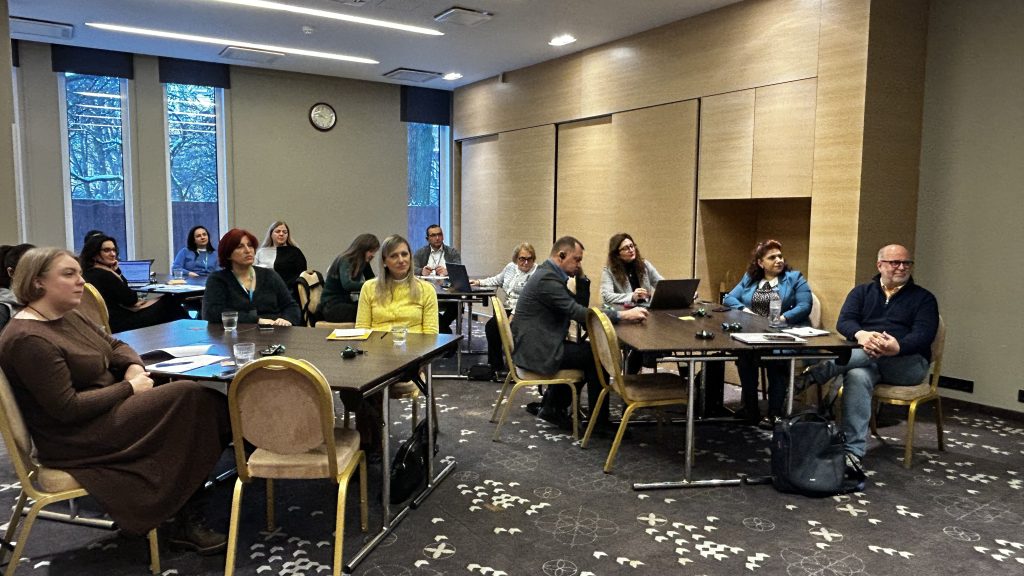
The Covenant of Mayors – East organised a two-day regional training bringing national communication experts together to explore how to strengthen public engagement on climate and energy at the local level. The event took place on 21–22 January 2026 in Tallinn, Estonia, and brought together national communication experts from Armenia, Azerbaijan, Georgia, Moldova, and Ukraine, as well as representatives of Covenant of Mayors support structures and civil society organisations.
The training addressed a shared challenge across the region: how to strengthen the role of communication by moving beyond its traditional function of information delivery and, where possible and appropriate, towards engaging citizens in climate and energy action. Discussions focused on how communication can support the implementation of climate and energy decisions, help municipalities explain policies clearly and accessibly, and create conditions for citizen participation in local action.
The Covenant of Mayors – Europe communication team shared experience from recently implemented engagement campaigns and reflected on lessons learned. One example was the City Refresh campaign, which helps cities adapt to extreme heat, alongside the Cities Heat Detox campaign, which helps cities explain the modernisation of heating systems. The speakers underlined that their communication activities are consistently aligned with current EU priorities and local strategic policy documents.
Using the City Refresh and Cities Heat Detox campaigns as case studies, participants analysed how working with clearly defined target audiences, strong visual identities, and a multi-channel approach can increase public awareness while directly supporting the implementation of concrete policy decisions at the city level.


Participants explored how the energy transition works in practice during a technical visit to the Utilitas Väo energy complex, one of Tallinn’s district heating operators. The district heating system supplies heat to around two-thirds of the city’s multi-apartment buildings. At the same time, the company is implementing a diversified decarbonisation strategy that combines biomass with solar generation, heat pumps, energy storage solutions, and preparations for hydrogen technologies.


Utilitas invests around €100 million annually in infrastructure development and modernisation. While Tallinn’s heating system was almost entirely dependent on natural gas in 2008, the company now aims to reduce its reliance on gas to ten percent by 2028. Participants also discussed the company’s tariff policy: the heat price of €75 per MWh applies equally to households and businesses, demonstrating how decarbonisation can be combined with transparency and social balance.
European Green Capital: the Tallinn experience
The second day of the training focused on how Tallinn prepared for and used its title of European Green Capital 2023. Kadri Kopli explained how the city transformed the title from a branding label into a practical governance tool.


Today, green areas cover around a quarter of Tallinn’s territory, while more than 130 gardens play a social role by supporting community-building. The city also actively manages its natural assets, including 46 kilometres of coastline, 18 lakes, three rivers, one island, and two wetland ecosystems. A long-term vision through 2035 has enabled Tallinn to develop a coherent approach in which climate neutrality, mobility, biodiversity, and community participation reinforce one another.
Biodiversity forms the foundation of Tallinn’s urban development, and the Pollinator Highway is a clear example of this approach in practice. The Pollinator Highway is a 14-kilometre-long green space, or green strip, running through several city districts and connecting urban green areas. Developed on previously underused land, it has been transformed into a convenient route for walking and cycling. At the same time, it serves an ecological function by providing a safe corridor for pollinators such as bees and bumblebees. Along the route, meadow areas, flower-rich zones, and community gardens are created, while some sections are left with minimal maintenance to preserve biodiversity. The project is developed gradually, with residents involved in discussions and solutions tested on a small scale to balance the needs of the city, people, and nature.


Experimental approaches to urban planning also play a key role. Through the Green Tracks initiative, Tallinn tested temporary green solutions ranging from flower meadows to micro-parks in the city centre. These pop-up interventions allowed the city to test ideas without large investments, collect feedback, and engage residents in co-creating public space. One example of institutionalised participation is the annual district-level voting process, with a budget of €1 million allocated to neighbourhood development.
Special attention was also given to governance structures supporting long-term change. The creation of the Green Capital Office strengthened coordination between municipal departments, businesses, and civil society, while the Test in Tallinn platform enables real-life testing of innovations in mobility, energy efficiency, and renewable energy within the urban environment.
Kadri Kopli also shared how the city communicated during this period. One of the campaign slogans, “wildly changing”, played on the double meaning of wild — referring both to nature and to the scale of transformation underway. The slogan linked the idea of bringing nature back into the city with a message of profound urban change. To reach private car drivers, the city used messages directly comparing travel times in traffic congestion, combined with outdoor advertising in key transport hubs such as railway stations, the airport, and the port. Tallinn also worked actively through its municipal newspaper, national and commercial television, EU media outlets, and even the BBC. Communication was broadly accessible, yet carefully embedded in residents’ everyday routes and information environments.
Communication for behavioural change


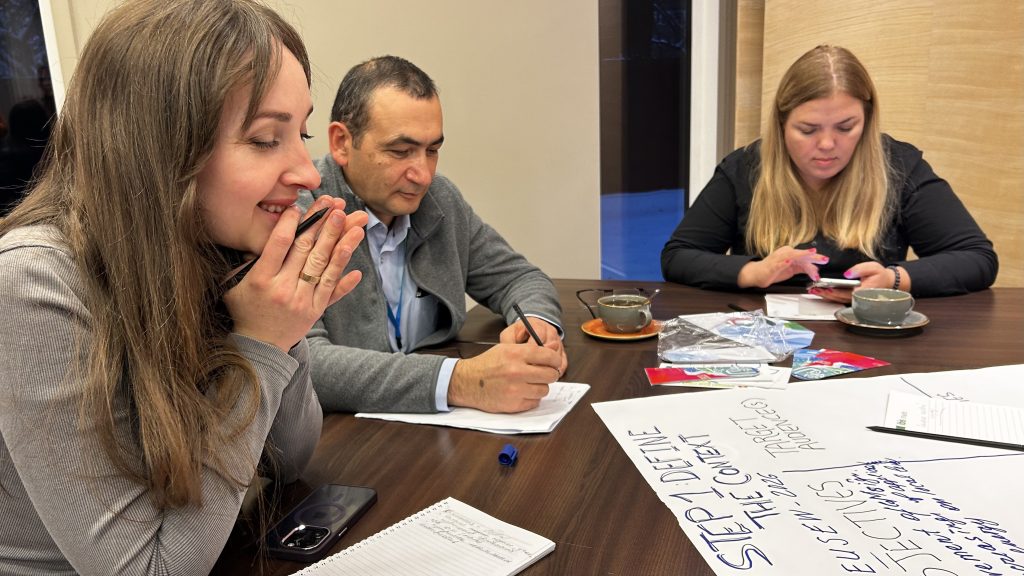
An important part of the training focused on communication for behavioural change, delivered by Ave Habakuk, a service designer and expert in behavioural approaches and design thinking in the public sector. Participants discussed how people actually make decisions on climate and energy issues — often guided not by rational arguments, but by social norms, emotions and the behaviour of others. The session highlighted that fear-based messaging and punishment can be counterproductive, while empathy-based communication and gradual change are more effective in addressing resistance to the green transition.
The training concluded with a meeting with the Green Tiger team, which demonstrated how civil society can strengthen institutional communication through creative formats, partnerships and informal channels, reaching audiences that traditional public communication often fails to engage.