


Case studies, District heating, Municipal buildings and facilities, Others, RES, Residential buildings, Street lighting, Transport
Covenant of Mayors celebrates 15th Anniversary in Eastern Partnership region
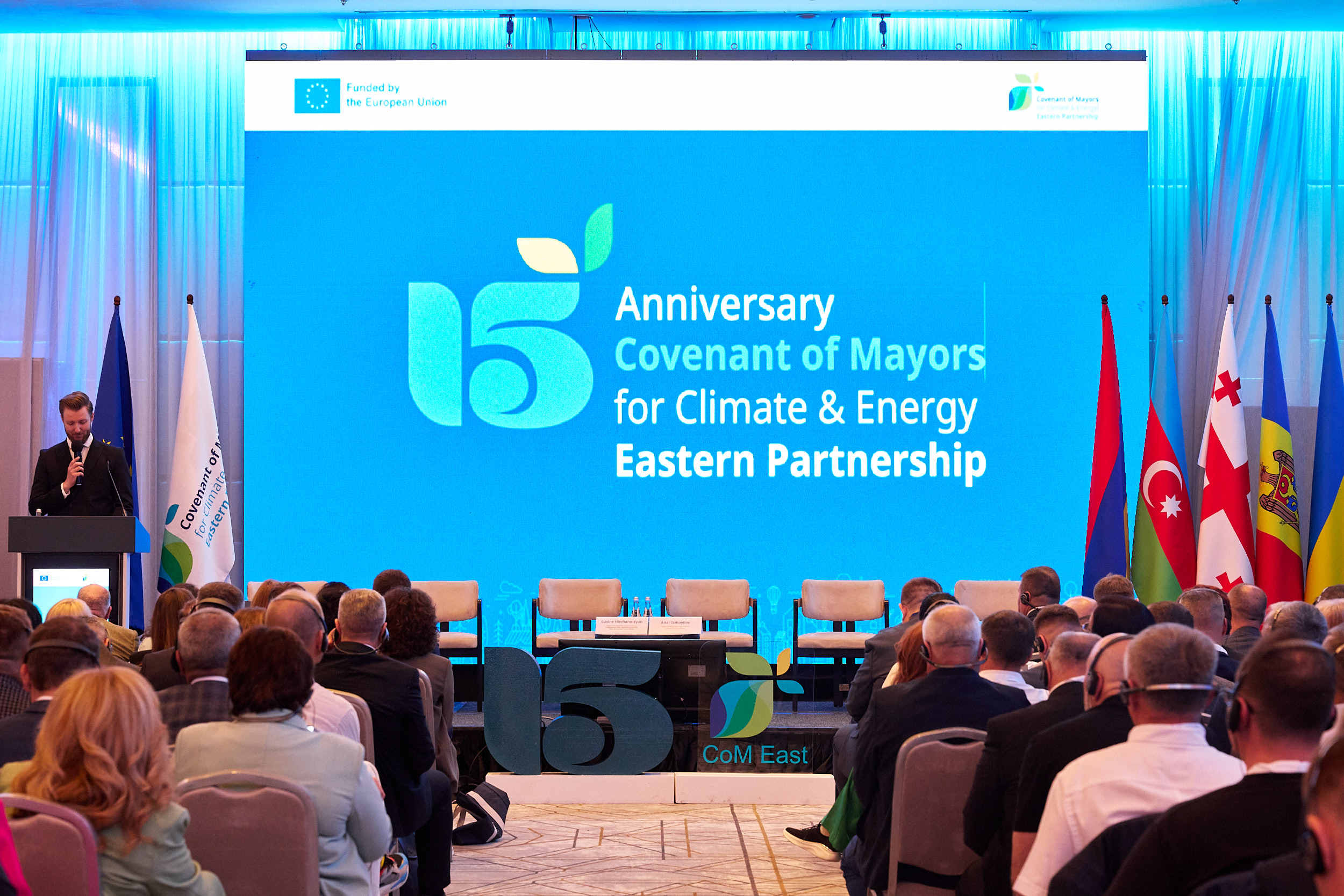
Organised in the framework of the EU-funded project Covenant of Mayors – East, the high-level conference ’15th Anniversary of the Covenant of Mayors in the Eastern Partnership Region’ took place on 20–21 May 2026 in Chișinău, Moldova. The conference brought together more than 200 representatives of signatory cities, national and EU institutions, international financial organisations, and partner initiatives from Armenia, Azerbaijan, Georgia, Moldova, and Ukraine, alongside EU Member States and international organisations, to mark fifteen years of local climate and energy action in the Eastern Partnership region and discuss the priorities for its next phase.
Iwona Piórko, Ambassador of the European Union to the Republic of Moldova, and Sergiu Lazarencu, Vice-President of the Parliamentary Committee for Environment, Climate and Green Transition of Moldova, opened the event. Ambassador Piórko underlined the progress achieved by municipalities over fifteen years of CoM East.
“When the Covenant of Mayors was launched by the European Union back in 2008, it was built on a simple but powerful idea — that cities and municipalities are essential actors in the transition towards a more sustainable future. Today, the Covenant of Mayors East brings together hundreds of municipalities representing a very significant share of the region’s population, all committed to improving energy efficiency, reducing greenhouse gas emissions, and strengthening resilience at the local level,” said Piórko.


“The Covenant of Mayors is important precisely because it transforms ambitions into concrete actions — it helps communities move from general environmental objectives to practical planning, from ideas to projects, from commitment to measurable results,” noted Lazarencu.
From lessons learned to the road ahead
The conference opened with a high-level panel on fifteen years of CoM East, moderated by Oleksander Senkevych, Mayor of Mykolaiv and CoM East representative in the Global Covenant Board. Mayors and municipal representatives from all five partner countries took the floor: Lusine Hovhannisyan from Stepanavan (Armenia), Anar Ismayilov, Mayor of Mingachevir (Azerbaijan), Mariana Mitrea, Deputy Mayor of Strășeni (Moldova), and Yuriy Fomichev, Mayor of Slavutych (Ukraine), reviewed fifteen years of results and discussed what separates cities that have moved from climate plans to build projects from those still working to close that gap.


The second session brought European cities with two decades of implementation experience. Jean-Patrick Masson, former Vice-President of Dijon Métropole (France), described how the city’s ResponsiCity project — more than 60 innovations in sustainable mobility and energy — succeeded not through technology alone, but through building strong internal teams and changing national regulations that had blocked the city’s solar-powered tramway.
Mario Rajn, Vice-Chair of Koprivnica-Križevci County (Croatia), showed what implementation looks like at the scale most European municipalities actually operate. Križevci has 18,000 people. Its climate action plan identified 29 measures; 19 were fully implemented. A micro-loan scheme for residents to invest in solar panels on public buildings grew into a local energy cooperative. Individual solar installations across the city rose from two in 2020 to 80 in 2021.


The third session addressed the financing gap — one of the most discussed challenges across the CoM East community. The opening point was direct: most municipalities today do not lack funding options. They lack projects ready to receive funding.
Serhii Morhunov, Mayor of Vinnytsia (Ukraine), described how his city replaced thousands of street lights with LED technology and deployed solar generation across hospitals and public transport — and linked both achievements to the quality of the city’s internal project preparation teams, which enabled partnerships with international financing institutions. Aneta Babayan, Director of Yerevan Municipality’s Project Implementation Unit (Armenia), showed how the city built that capacity from scratch. Roman Ciubaciuc, Mayor of Cantemir (Moldova), addressed the specific constraints smaller municipalities face in accessing climate finance.


Alberto Carlei, Head of the European Investment Bank Representation to Moldova, said that for investors, bankability means more than financial indicators — it includes environmental and social standards, risk planning, and a municipality that can demonstrate institutional readiness to deliver.
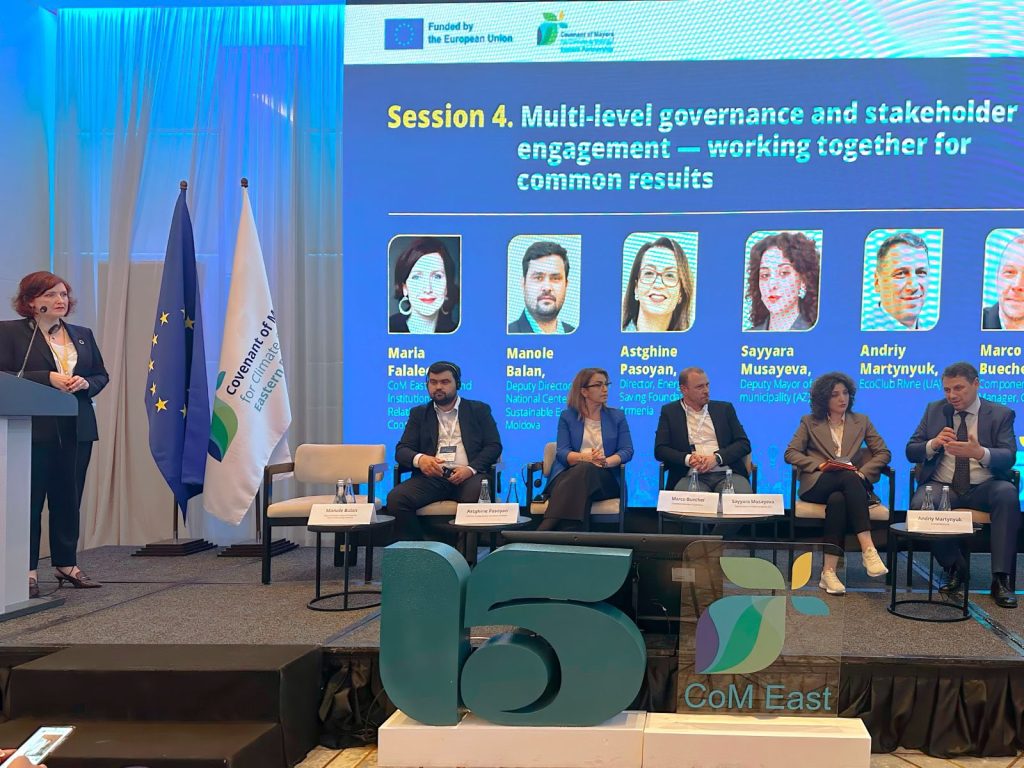
Session IV on multi-level governance examined coordination between city climate plans and national policy frameworks. Astghine Pasoyan, Director of the Energy Saving Foundation Armenia, Sayyara Musayeva, Deputy Mayor of Sheki (Azerbaijan), and Marco Buechel, Component Manager at GIZ Moldova, joined national energy agency representatives and civil society organisations from across the region to discuss where national and local ambitions align — and where they do not.
The last session held at the Castel Mimi complex on the second day examined integrated urban resilience under multiple climate-driven crises. Svitlana Sushko, Team Leader of the Reform and Recovery Support Team at Ukraine’s Ministry of Economy, Environment and Agriculture, described how Ukrainian municipalities are integrating climate adaptation into post-war recovery planning. For cities operating under active conflict, energy independence is no longer a strategic ambition — it is a daily operating condition. Participants from Georgia, Moldova, and Ukraine shared approaches to building climate resilience under complex political and security pressures.


Marking achievement: the CoM East Awards
On the evening of 20 May, CoM East recognised eight signatory municipalities for progress in low-carbon and climate-resilient development. Chosen from 67 applications across Armenia, Azerbaijan, Moldova, and Ukraine and scored by an independent expert jury, the winning cities were: Vanadzor (Armenia), Sheki (Azerbaijan), Ceadir-Lunga and Sireti (Moldova), and Chernivtsi, Myrhorod, Rivne, and Slavutych (Ukraine).
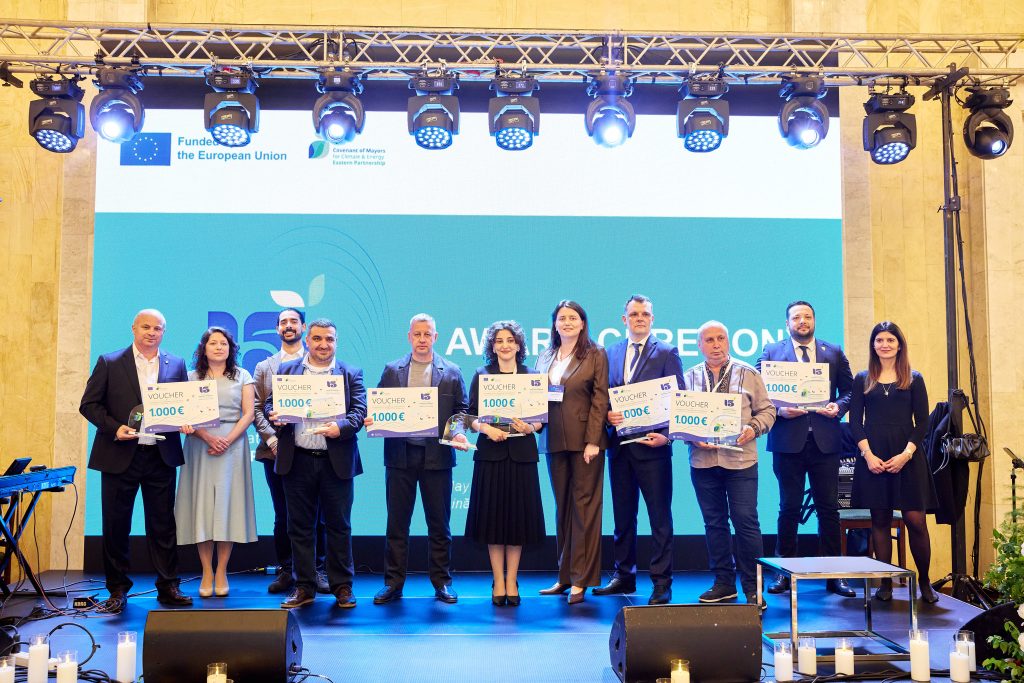
Each also received a voucher of up to €1,000 for follow-up activities, including tree planting or local awareness campaigns.
Learning from Castel Mimi
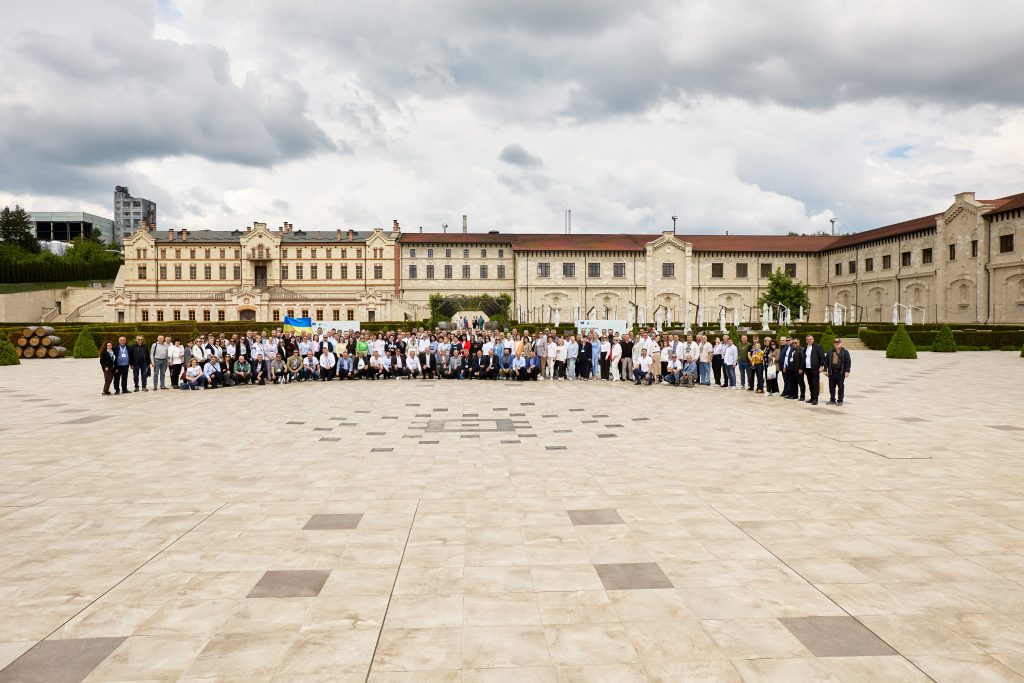
The second day of the conference took place at the Castel Mimi complex — a winery and cultural site working towards zero-emission operations and winner of the Green Award. Following Session V, participants took a guided tour of the facilities, covering energy efficiency and renewable energy systems, circular economy and waste management, sustainable agriculture, and community engagement. Participants travelled from Chișinău by private train to reduce CO₂ emissions from the transfer.
In 2024, CoM East cities adopted a long-term climate goal of at least 60 percent greenhouse gas emission reduction by 2050 compared with the baseline. Moldova and Ukraine, EU candidate countries since 2022, are aligning national legislation with EU climate and energy standards as part of their accession processes. The 15th Anniversary Conference confirmed that the focus of the next phase of CoM East will be on turning that alignment into delivery: building municipal capacity for investment-ready projects, developing blended finance models, and connecting local governments more directly with national authorities and EU institutions.