


Case studies, District heating, Municipal buildings and facilities, Others, RES, Residential buildings, Street lighting, Transport
Fifteen years on: a fireside chat with Christophe Frering
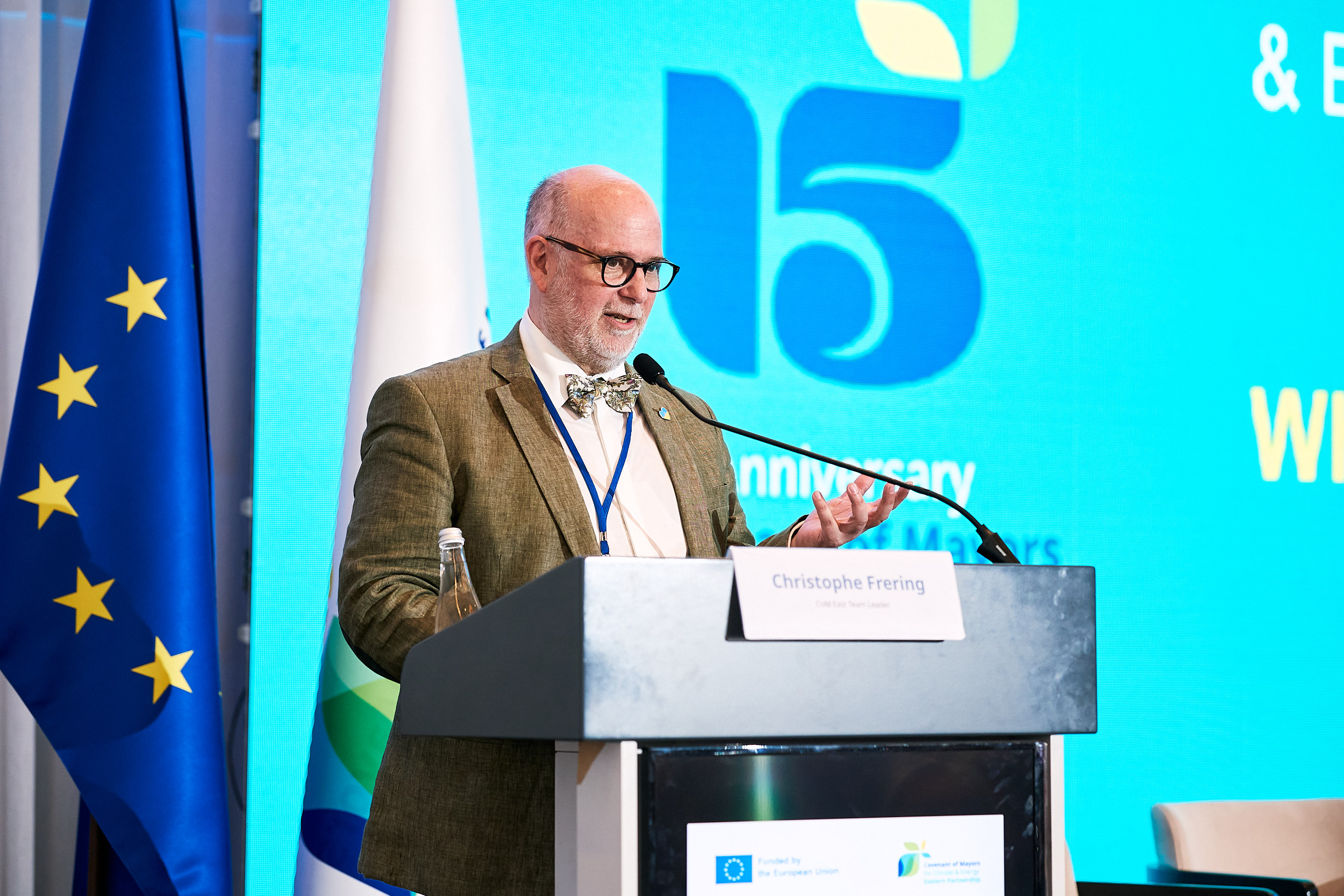
Christophe Frering has coordinated the Covenant of Mayors – East (CoM East) as Team Leader since the initiative was launched 15 years ago. He has overseen CoM East’s work with hundreds of municipalities across Armenia, Azerbaijan, Belarus, Georgia, Moldova and Ukraine — through energy crises, armed conflicts and the daily friction of institutional change.
On the occasion of the initiative’s 15th anniversary, marked at a conference in Chișinău on 20–21 May 2026, we sat down with Christophe for a conversation about what these past 15 years have actually looked like from the inside.
You’ve been with CoM East since day one. What did you think this initiative would become — and how does that compare to what it actually is today?
I was enthusiastic — but to be honest, also a bit sceptical. The gap to bridge was so huge. In 2011, the Eastern Partnership countries were at very different starting points from their Western European counterparts — in terms of municipal financial autonomy, technical capacity and political culture around energy governance.
The gap with many EU cities is still there. But the transformation process has started, and many Eastern Partnership signatory cities are actively committed and performing well.
Fifteen years is a significant milestone. In human terms, fifteen is the age of a teenager — no longer a child, not yet fully independent, but with a character that is clearly its own. I think CoM East is at that stage. The initiative has developed its own strengths, its own ways of doing things, its own community of people who believe in it. And like a teenager, it is at the point where you start thinking seriously about what comes next — how it stands more on its own, how the municipalities we have supported continue to move forward with greater independence, relying less on external support and more on the capacity, the networks and the habits they have built over these years.
What’s the biggest thing you got wrong in the early years?
Planning everything too far in advance.
When you launch something new, there is a temptation to map out every step — detailed workplans, fixed timelines, rigid deliverables. I learned to plan with shorter horizons and more flexibility.
Is there a decision from those first years that you’d make differently now?
Trying to change administrative — not to say bureaucratic — habits. Why try to change minor things when they work?
Has working in this region changed how you think about climate action more broadly?
My approach became a bit more pragmatic.
I arrived thinking that good planning, solid technical support and the right political framework would be enough to drive change. And those things matter — they are what CoM East provides. But I came to understand that the pace of change is determined by factors well outside our control: national fiscal policy, the political cycle, the capacity of individual municipalities to absorb and retain expertise. Progress here looks different. It is slower, more uneven, and often more fragile. I have made peace with that.
What’s the problem you’ve been trying to solve for 15 years that still hasn’t been solved?
Convincing municipalities to invest in their expert staff and then keep them. Once CoM East trains someone, the private sector comes calling.
CoM East puts a lot of efforts into building capacity — energy managers, technical staff, people who can write a SECAP, run a monitoring system, manage a multi-year project. Those skills are valuable, and not only to the municipality. The moment someone completes a good training programme, they become attractive to private firms, other international organisations, NGOs. The private sector can pay two or three times what a municipal budget allows. We lose good people, and so do the municipalities. I do not have a solution to this. It is a structural problem that requires national-level decisions about public sector salaries that are well beyond CoM East’s reach.
Is there a moment that made you seriously question whether this approach was working — and what kept you going?
Not really. I try to stay optimistic and think that our mission would be successful even if only a few of the cities we support move ahead, hoping they would then become visible enough examples for others to follow.
The logic is simple: you do not need everyone to move at once. You need a few cities that get it right, that demonstrate what is possible, and that other municipalities can learn from. In a region where peer learning is one of the most powerful tools we have, that matters. I have seen it work — a city does something well, presents it at a regional event, and three other mayors go home thinking differently. That is slow progress by some measures. But it is real progress.
Is there a specific mayor or official whose journey has stayed with you?
There are several officials I have known almost since I started working on CoM East — mayors and deputy mayors who have stayed in post and kept their communities moving forward. They have been re-elected regularly. Their citizens recognise what has been done.
Among them are Mr. Grigoryan from Stepanavan in Armenia, Ms Musayeva from Sheki in Azerbaijan, Ms. Latsabidze from Rustavi in Georgia. There are many in Moldova, such as Mr. Topal from Ceadir-Lunga, Mr. Boaghi from Sireti, Ms Costiuc from Budesti, Mr. Ciubaciuc from Cantemir, Ms. Pilipețchi from Soroca, Ms. Casian from Straseni, Ms. Pac from Visniovca, and also in Ukraine – Mr. Fomichev from Slavutych, Mr. Shmatko from Chortkiv, Ms. Moroz from Kharkiv Regional Council, Mr. Serniak from Pustomyty, Mr. Senkevych from Mykolaiv, and many others.
What strikes me about all of them is the continuity. In this region, political continuity at the municipal level is not guaranteed. Elections happen, priorities change, and long-term programmes get interrupted. These are people who stayed the course — not just in office but in direction. That consistency is what makes the difference between a city that starts well and a city that actually gets somewhere.
What still surprises you about this work?
All the small but regular steps that a collective effort between an expert team and municipal teams — mayors, deputy mayors, energy managers, technical staff — can achieve.
After 15 years, you might expect this to stop being surprising. But it still is. The work is slow, the obstacles are real, and the progress is often invisible until you look back across a decade and see how far a city has come. That collective effort — all our CoM East team and in particular our country experts, but also the municipal staff — is what makes any of it possible. I am proud of that.
What are your thoughts for the future when you are about to leave CoM East for a well-deserved retirement?
Well, I am very confident because I know that with the continuous support of the European Union, the CoM East initiative, the CoM East support team and the entire CoM East community will maintain quality work, concrete achievements, and great results for the well-being of our fellow citizens throughout this beautiful and friendly Eastern Partnership region.
And I am sure this will continue, in spite of the negative forces at work, for many years, and particularly since 2022! And, if you allow me, I would like to conclude with a personal but important message by paying a special tribute to all our Ukrainian friends and partners who, for too long a time, have been fighting hard for our common European values and freedom!!!
Слава Україні