


Case studies, District heating, Municipal buildings and facilities, Others, RES, Residential buildings, Street lighting, Transport
Ukrainian signatory turns solar panels and strategic planning into climate results

Opishnia, a community in Poltava region in central Ukraine, joined the Covenant of Mayors in 2023 and committed to reducing CO₂ emissions, improving energy efficiency and adapting to climate change. Since then it has installed solar panels on its schools, kindergartens and water supply infrastructure, and built a municipal team that no longer makes energy decisions on the fly.
As the Covenant of Mayors – East (CoM East) initiative marks its 15th anniversary, Opishnia’s experience illustrates that local climate action is about decisions, and not one-off projects but a shift in how a community thinks about its future.
From improvisation to strategy
Before joining the Covenant of Mayors, energy management in Opishnia — as in many Ukrainian hromadas — was largely reactive. Problems were addressed as they arose. There was no systematic analysis of consumption, no long-term targets, no mechanism to prioritise investments.
Joining the Covenant of Mayors changed that. Participation gave the municipality access to methodological support, energy planning tools and a framework for setting priorities and tracking progress.
“This was a strategic step towards sustainable development,” said Mykola Riznyk, head of Opishnia hromada. “It allowed us to move to systematic energy planning, attract international support and implement energy efficiency projects.”
The result, Riznyk said, was lower energy costs, better conditions in public facilities and a community more aware of its environmental responsibilities.
Panels on schools, kindergartens and water supply
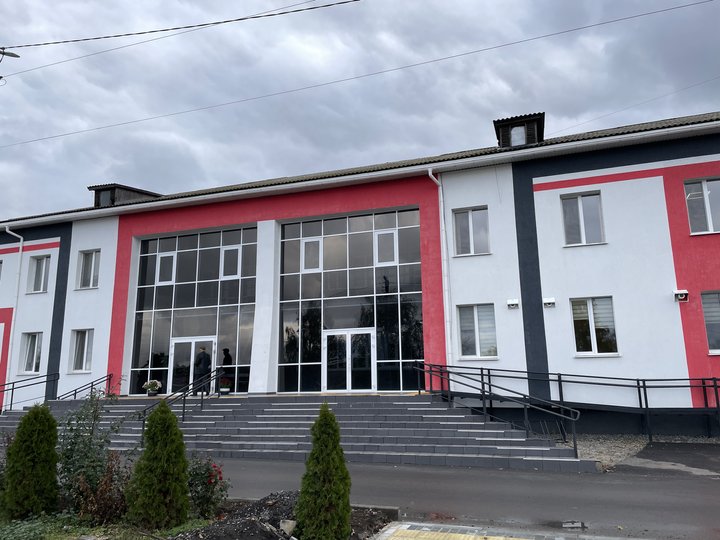
The most visible outcome of that planning is a series of solar photovoltaic installations on key public infrastructure. Solar panels now operate on the roofs of schools, kindergartens, the municipality’s administrative services centre and the boreholes that supply the hromada with water.
The choice of sites was deliberate. These are facilities that cannot afford to stop working — particularly in the context of Ukraine’s ongoing energy challenges, where grid power is frequently disrupted. By generating their own electricity, these facilities have reduced their dependence on the national grid, cut running costs and maintained continuity of services for residents.
Climate targets are made local
Opishnia’s approach reflects a wider argument CoM East has been making for 15 years: that national and European climate targets are only achieved if municipalities translate them into concrete action.
“It is at the local level that climate goals move from declarations into practice,” Riznyk said.
The Covenant of Mayors framework gives municipalities the tools to plan emission reductions, track progress and demonstrate results — which makes local governments effective actors in a national climate strategy, rather than passive recipients of central policy.


What CoM East provided
Participation in the EU-funded CoM East initiative gave Opishnia access to methodological support, expert guidance and a network of peers working on the same challenges.
“CoM East provided methodological support, access to expertise and modern energy planning tools,” said Riznyk. “Cooperation with international partners opened opportunities to attract financing and implement projects. Thanks to this, the community was able to move from ideas to practical solutions.”
The result, he said, was greater energy efficiency, stronger energy independence and a municipality better equipped to withstand the pressures its residents face today.
A change in behaviour, not just infrastructure

The most durable outcomes may be the ones hardest to measure. Residents in Opishnia are paying more attention to how they use energy. Waste sorting is spreading. Awareness of renewable energy and environmental responsibility is growing. The combination of practical projects and public awareness work is building more responsible attitudes towards the environment.
The CoM East has always argued that the transition to clean energy is not only a technical or financial challenge, but a cultural one. Infrastructure matters, but so does the community’s relationship with it.
The shift is visible inside the municipality itself. The management team now works from long-term data rather than short-term instinct. Cross-sector coordination has improved. Energy consumption is analysed regularly.
“We work with a long-term horizon and build solutions that have a lasting effect,” Riznyk said.